Nederlands
  Français
  Deutsch
  Italiano
  Español
  Português

Vondelpark
Vondelpark is located between Amsterdam-Zuid and Amsterdam-West, directly southwest of the historic centre. The park opened in 1865 and covers around 47 hectares. Its central location makes it Amsterdam's best-known and one of its busiest green spaces.The park has a long, narrow layout, with paved cycling and walking routes passing lawns, ponds, mature trees and gardens. This makes Vondelpark particularly convenient to explore by bicycle. You can enter near Museumplein or Leidseplein, cycle through the full length of the park and continue towards Amsterdam-West or Amsterdam-Zuid.
Before exploring, take a look at the official Vondelpark map. It shows the layout of the park and makes it easier to find attractions, gardens, playgrounds and other facilities.
Several well-known areas of Amsterdam are within easy cycling distance. Museumplein is east of the park, Leidseplein is near its northeastern entrance, and neighbourhoods such as Oud-West and Schinkelbuurt are located to the west.
What to see and do in Vondelpark
Vondelpark is more than a route through the city. The park contains a rose garden, ponds, large lawns, playgrounds and several cafés and restaurants. In summer, the lawns become popular places for picnics, while the quieter western sections of the park generally feel less crowded than the entrances closest to the city centre.
Families will find several playgrounds throughout the park. There is also a shallow children's paddling pool that is normally used during the warmer months. For more family activities elsewhere in the city, see our guide to things to do with kids in Amsterdam.
Vondelpark Openluchttheater
During the warmer months, the Vondelpark Openluchttheater is one of the park's main cultural attractions. The open-air theatre has been part of Amsterdam's summer culture for decades and hosts performances from May into September.
The programme includes live music, comedy, dance, classical music and family theatre. Performances are generally free to attend, although visitors are encouraged to make a voluntary contribution. You can check the current programme before visiting to see whether a performance fits into your cycling route.
Location: Vondelpark 5A, 1071 AA Amsterdam
Breakfast or lunch at Dignita Vondelpark
If you want to combine your ride with breakfast, brunch or lunch, Dignita Vondelpark is located close to the southern side of the park. It is a convenient stop before entering Vondelpark or after cycling through it, particularly if your route continues towards Amsterdam-Zuid.
Dignita specialises in all-day brunch and makes a practical stopping point for a longer day of cycling through Vondelpark and the surrounding neighbourhoods.
Cycling through Vondelpark
The landscape changes noticeably as you travel through the park. Some sections consist of wide lawns used for picnics and recreation, while others contain dense groups of trees, ponds and narrower paths. Cycling the full length of the park therefore gives a better impression of Vondelpark than only visiting the busy eastern entrance.
Cyclists should take particular care around entrances and central sections. Vondelpark is heavily used by pedestrians, runners, children and other cyclists, so it is better suited to relaxed cycling than travelling at speed.
If you do not have your own bicycle, you can rent a bike in Amsterdam and combine Vondelpark with Museumplein, Oud-West, Amsterdam-Zuid or other parks nearby.
Westerpark and Westergas
Westerpark is directly west of the Jordaan and Haarlemmerbuurt. It forms part of a larger recreational and cultural area that includes Westergas, where former gasworks buildings have been converted for new uses.This combination gives Westerpark a different character from most Amsterdam parks. The eastern section resembles a traditional city park, with grass, trees and water. Farther west, green spaces mix with historic industrial architecture and cultural venues.
From industrial site to city park
The Westergasfabriek complex was constructed in the late 19th century to produce gas for Amsterdam. After industrial activities ended, the area was redeveloped. The surviving buildings now form part of the Westergas cultural complex.
Cycling through the area allows you to see both sides of Westerpark. You can move from the landscaped park into the former industrial site without leaving the wider green area.
Westerpark also sits near useful cycling routes. From here, you can continue west towards Amsterdam-West or north towards the areas around the IJ. Heading east brings you back towards Haarlemmerdijk and the historic centre.
Oosterpark
Oosterpark is one of the main green spaces in Amsterdam-Oost. The park was created in the late 19th century and was the first large municipal park established by the city of Amsterdam.Its landscape is centred around lawns, mature trees and a large pond. Compared with the long shape of Vondelpark, Oosterpark has a more compact layout. It is therefore easy to explore during a shorter stop.
What is around Oosterpark?
The park sits in a particularly diverse part of Amsterdam-Oost. The Wereldmuseum Amsterdam is located beside the park. Dappermarkt and the Dapperbuurt are nearby, while the streets around Linnaeusstraat provide connections farther into Amsterdam-Oost.
Oosterpark also contains several monuments and works of art. One of the most significant is the National Monument Slavery Past, which commemorates the history and legacy of Dutch slavery.
For cyclists, Oosterpark works well as part of a wider route through eastern Amsterdam. You can combine it with Dappermarkt, Indische Buurt, Park Frankendael or the area around the Amstel.
Hortus Botanicus Amsterdam
The Hortus Botanicus Amsterdam provides a very different type of green space. Located in the Plantage neighbourhood, it is one of Amsterdam's historic botanical gardens and contains an extensive collection of plants from around the world.The garden includes outdoor planting, ponds and several greenhouses where visitors can see plants that would not normally survive outdoors in the Dutch climate. Its compact layout makes the Hortus suitable as a shorter stop when exploring the eastern side of Amsterdam.
Unlike most of the parks in this guide, the Hortus is a ticketed attraction and is intended to be explored on foot. Park your bicycle nearby before entering the garden.
Its location also makes it easy to combine with other places in the Plantage neighbourhood. Oosterpark, Waterlooplein and the eastern canal belt are all relatively close, so the Hortus can form part of a longer cycling route through this side of the city.
Location: Plantage Middenlaan 2A, 1018 DD Amsterdam
Rembrandtpark
Rembrandtpark covers 45 hectares in Amsterdam-West. It lies between De Baarsjes and Overtoomse Veld.The park is noticeably less tourist-oriented than Vondelpark. Most visitors are residents from surrounding neighbourhoods, which gives it the character of a local recreational park.
Cycling through Rembrandtpark
The long north-south layout makes Rembrandtpark useful for cycling. Paths pass through areas with trees, lawns and water, with several bridges connecting different sections.
If you are staying in or exploring Amsterdam-West, the park can form part of a route between different neighbourhoods. It can also be combined with Vondelpark. The two parks are separated by a relatively short urban stretch.
Rembrandtpark is particularly interesting if you want to see how green spaces fit into Amsterdam's residential districts. Instead of major museums or cultural attractions, the surroundings consist mainly of housing, schools and neighbourhood facilities.
Beatrixpark
Beatrixpark is located in Amsterdam-Zuid, between the residential streets of the Prinses Irenebuurt and the modern buildings of Zuidas. RAI Amsterdam is also nearby.The park was created in the 1930s. Mature trees and established planting give parts of it a different atmosphere from newer recreational areas in the city.
A park between old and new Amsterdam
One of the interesting aspects of Beatrixpark is its surroundings. On one side are residential streets built as Amsterdam expanded south. On the other are the high-rise offices and apartment buildings of Zuidas.
That contrast is particularly clear when cycling through the area. Within a short distance, the route changes from traditional Amsterdam neighbourhoods to a major business district and then into a green park.
Beatrixpark is also useful when cycling south from the centre. From Museumplein and De Pijp, you can continue through Amsterdam-Zuid and use the park as a stop before travelling farther towards Buitenveldert or Amsterdamse Bos.
Noorderpark
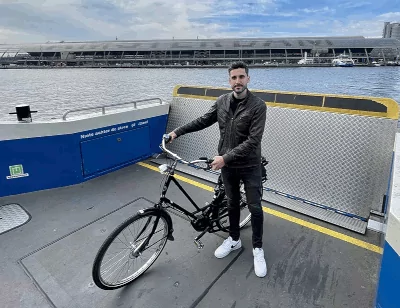
Noorderpark is in Amsterdam-Noord, on both sides of the Noordhollandsch Kanaal. For visitors starting in the centre, getting there usually involves crossing the IJ before continuing north by bicycle.The free ferries behind Amsterdam Centraal carry both pedestrians and cyclists. Once across the water, Amsterdam-Noord has an extensive network of cycling routes.
Exploring Amsterdam-Noord from the park
Noorderpark is more than an isolated green space. Its location makes it a useful part of a longer route through Amsterdam-Noord.
The park contains lawns, trees, recreational areas and playgrounds. The Noordhollandsch Kanaal divides the landscape, with bridges connecting different sections.
From Noorderpark, cyclists can continue through residential parts of Noord or travel farther towards the greener outskirts of Amsterdam. This makes the park a useful transition point between the denser urban areas around the IJ and the quieter areas farther north.
Amsterdamse Bos
The Amsterdamse Bos is the largest green area on this list. It covers around 1,000 hectares, making it more than 20 times the size of Vondelpark. Despite the name, it is not entirely within Amsterdam. A substantial part lies in the municipality of Amstelveen.Construction of Amsterdamse Bos began in the 1930s. The landscape was deliberately designed to combine woodland, open fields, waterways and recreational facilities.
Its scale changes the cycling experience completely. While you can cross a city park such as Oosterpark relatively quickly, exploring Amsterdamse Bos can take several hours.
What can you find in Amsterdamse Bos?
The forest contains an extensive network of paths. Some are intended for cyclists, while others are primarily for pedestrians, horse riders or other users. Following signs is therefore important.
There are large woodland areas, open grasslands and several bodies of water. The Bosbaan is one of the most recognisable features. This rowing course runs through the northern section of the forest and has been used for rowing competitions for decades.
De Nieuwe Meer lies to the north of the forest, while the landscape becomes increasingly spacious as you travel south.
The Geitenboerderij Ridammerhoeve is another well-known destination within Amsterdamse Bos. The organic goat farm is particularly popular with families and has goats and other farm animals, a playground, farm shop and restaurant. It is located deep enough inside the forest that cycling is a practical way to reach the surrounding area.
Families can find more playgrounds, swimming options and activities around the city in our guide to things to do with kids in Amsterdam.
Cycling to Amsterdamse Bos
From central Amsterdam, the forest is best approached through Amsterdam-Zuid. A route can take you past Museumplein, through the southern districts and towards the northern entrances of the forest.
Once inside, distances are considerably greater than in Amsterdam's city parks. Check your route before travelling if you have a specific destination within the forest.
For visitors who want to spend a significant part of the day cycling away from traffic and dense urban streets, Amsterdamse Bos offers considerably more distance than the parks closer to the centre.
Park Frankendael
Park Frankendael is located in Watergraafsmeer in Amsterdam-Oost. Its history differs from most public parks in the city because the site developed around a historic country estate.At its centre stands Huize Frankendael, the only surviving historic country estate in Amsterdam. Wealthy Amsterdam residents once established estates in Watergraafsmeer to escape the crowded city.
Gardens and historic surroundings
Park Frankendael combines open lawns with more formal landscaped sections. The historic house and gardens create a noticeably different environment from parks such as Westerpark or Rembrandtpark.
The park is relatively compact. Instead of cycling around for a long period, it makes more sense to include it as a stop on a route through Amsterdam-Oost.
Watergraafsmeer itself is also worth exploring by bicycle. The neighbourhood has wider streets and more open development than the historic canal district. From Park Frankendael, you can continue towards the Amstel, Oosterpark or other parts of Amsterdam-Oost.
Some areas of Park Frankendael are intended for pedestrians. Pay attention to local signs and park your bicycle before entering sections where cycling is not permitted.
Erasmuspark
Erasmuspark is a smaller neighbourhood park in Amsterdam-West, close to Bos en Lommer and De Baarsjes. It covers 12 hectares and is surrounded by water.Because of its size, Erasmuspark is not a destination where most visitors will spend an entire day. It is more useful as a green stop when exploring western Amsterdam by bicycle.
The park has lawns, trees, walking paths and areas used for recreation. Its relatively compact dimensions make it easy to combine with other locations nearby.
A cycling route can continue from Erasmuspark towards Westerpark to the northeast or Rembrandtpark farther south. Combining these parks is a useful way to explore Amsterdam-West beyond the streets most visitors see in the centre.
Flevopark
Flevopark is on the eastern side of Amsterdam, next to the Indische Buurt. It opened in 1931 and occupies a quieter position near the edge of the city's denser neighbourhoods.The park contains large areas of grass, trees and water. Because it sits farther from the historic centre, it generally has a more local character than Vondelpark.
Combining Flevopark with Amsterdam-Oost
Flevopark is particularly useful as the eastern end of a cycling route through Amsterdam-Oost. From the centre, you can travel through areas around Oosterpark and Dappermarkt before continuing through the Indische Buurt.
The park is also close to Nieuwe Diep, a body of water that helps give this part of Amsterdam a more open landscape.
Cyclists who want to see several eastern neighbourhoods can combine Oosterpark, Park Frankendael and Flevopark in the same day.
Diemerpark
Diemerpark is a large green area in Amsterdam-Oost close to IJburg. The site has an unusual history: it was once used as a waste disposal area and was later transformed into the park visitors see today.The result is a spacious landscape with considerably more open nature than the parks closer to the centre. Hard-surfaced paths through the park are suitable for cycling, making Diemerpark a natural extension of a longer route towards IJburg.
The park also has sports fields, running routes and an open-air theatre. There is a small beach where swimming is permitted, making the area particularly attractive during warmer weather.
Diemerpark works particularly well in combination with Flevopark and IJburg. Cyclists can continue east through Amsterdam-Oost and gradually leave the dense inner-city neighbourhoods behind.
Nelson Mandelapark
Nelson Mandelapark is one of the main parks in Amsterdam-Zuidoost. Before 2014, it was known as Bijlmerpark.The park is designed around both recreation and sport. Walking, running and cycling routes cross the area, while sports facilities include basketball and football areas, exercise equipment and a skatepark.
There are also play areas for children and plenty of open green space. This makes Nelson Mandelapark useful for families as well as visitors who want to include a quieter and less tourist-oriented part of Amsterdam in their cycling route.
For cyclists, the park can form part of a longer route through Amsterdam-Zuidoost. It can be combined with Gaasperplas and the greener areas south and east of the Bijlmer.
Amstelpark
Amstelpark lies in Amsterdam-Zuid beside the Amstel river. The park was developed as one of the main locations for Floriade 1972, an international horticultural exhibition.That history is still visible in its layout. Amstelpark has landscaped gardens, carefully planted areas and recreational facilities rather than the large open lawns that dominate some other Amsterdam parks.
The park is also a good option for families. There are play areas for children, a maze, a city farm and other attractions throughout the park. Families looking for more ideas can also read our guide to things to do with kids in Amsterdam.
Another popular activity is Minigolf Amstelpark. Visitors can choose between an 18-hole traditional minigolf course with obstacles and an 18-hole grass course. There is also a pancake restaurant and terrace, making it an easy place to stop during a longer visit to the park.
Cycling is not permitted throughout much of Amstelpark itself. If you arrive by bicycle, use the designated parking facilities and explore the interior on foot.
The journey there is still worthwhile by bike. Routes along the Amstel provide a direct connection from central neighbourhoods towards the southern parts of the city. You can also combine Amstelpark with a longer ride along the river.
For a varied day, explore Amstelpark in the morning and combine it with time on Amsterdam's canals later in the day. After cycling back towards the city, you can rent your own boat in Amsterdam and explore the canals from the water.
Spaarnwoude Park
For a substantially longer cycling trip, Spaarnwoude Park provides a large recreational landscape between Amsterdam, Haarlem and Hoofddorp. Unlike Amsterdam's compact city parks, Spaarnwoude consists of extensive green areas, polders, woodland, waterways and recreational facilities.The area is particularly well suited to cycling. There are dedicated cycle paths and several marked cycling routes, so Spaarnwoude works better as a half-day or full-day destination than as a short park stop.
One option is the 17-kilometre route through the area that passes historic forts, windmills and sections of the old landscape around Halfweg and Spaarnwoude. Other parts of the park offer opportunities for walking, swimming and other outdoor activities.
Spaarnwoude is also considerably quieter and more open than central Amsterdam. It is a good choice for visitors who want to use a bicycle to leave the city completely and experience the wider Dutch landscape.
The park is easily approached by bicycle from the western side of Amsterdam. Halfweg can also be used as a starting point for routes through the recreation area.
Choosing a park for your cycling route
The best park depends on which part of Amsterdam you want to explore. Vondelpark fits naturally into a route around Museumplein, Oud-West and Amsterdam-Zuid. Westerpark can be combined with the Jordaan and western parts of the city.For eastern Amsterdam, Oosterpark, Hortus Botanicus, Park Frankendael and Flevopark work well as shorter stops. Cyclists who want to continue farther east can add Diemerpark and IJburg to create a substantially longer route.
For Amsterdam-Noord, Noorderpark is an accessible starting point after crossing the IJ. Rembrandtpark and Erasmuspark are useful if you want to spend more time exploring residential Amsterdam-West.
Nelson Mandelapark is a good option for exploring Amsterdam-Zuidoost and can be combined with Gaasperplas. Amsterdamse Bos requires more time but provides the greatest amount of space close to the city for a longer recreational ride.
Amstelpark is better treated as a destination where you park the bicycle and continue on foot, while Spaarnwoude is the strongest option on this list for visitors who want a much longer ride outside central Amsterdam.
If you want to explore several of these parks in one day, you can rent a bike from Black Bikes and choose from rental locations across Amsterdam.
Rules for cycling in Amsterdam's parks
Being able to enter a park with a bicycle does not mean you can cycle on every path. Some paths are reserved for pedestrians, and rules differ between parks. Always follow the signs at entrances and along the route.Keep your speed low when sharing space with pedestrians. This is especially important in Vondelpark, where large numbers of cyclists, runners, walkers and children use the same area.
When stopping, use bicycle racks or designated parking areas where available. Do not leave a bicycle across a footpath or entrance.
If you are using one of our rental bikes to explore Amsterdam's parks, our employees can also explain how to reach different parts of the city and how to use Amsterdam's cycling infrastructure safely.
Use a bike your entire stay