 Nederlands
  Français
  Deutsch
  Italiano
  Español
  Português

Historical Context
Nieuwmarkt is one of the oldest parts of Amsterdam. The square developed beside the medieval city walls around the Sint Antoniespoort, the former city gate that later became De Waag. As Amsterdam expanded beyond its walls, the gate lost its original defensive function and the surrounding area became increasingly integrated into the growing city.Rembrandtplein also developed in connection with Amsterdam's former fortifications. The area originated around the Regulierspoort, one of the entrances to the city. After Amsterdam expanded during the 17th century, the former entrance became a market area known as the Botermarkt, where dairy products and poultry were traded. The square was also an important location for Amsterdam's annual fair.
A statue of Rembrandt was placed here during the 19th century, and the square was officially named Rembrandtplein in 1876. Around the turn of the 20th century it developed into an important entertainment district, with cafés, terraces, hotels, theatres, and other venues attracting both residents and visitors.
The eastern city center also became closely connected to Amsterdam's Jewish history. From the late 16th and 17th centuries onwards, Jewish refugees and immigrants settled in Amsterdam, including Portuguese and Spanish Jews fleeing persecution on the Iberian Peninsula and, later, Jews arriving from Central and Eastern Europe. The areas around Waterlooplein, Jodenbreestraat, Nieuwe Herengracht, and Plantage became important centers of Jewish life.
The present-day Waterlooplein was created in the 19th century when the Houtgracht and Leprozengracht were filled in. Market traders from the surrounding streets moved onto the new square, establishing the market tradition that continues today.
Further east, Plantage developed differently from the densely built streets around Nieuwmarkt and Waterlooplein. During the late 17th century, the city designated this relatively undeveloped area for gardens, green spaces, and places of recreation. This history helps explain the wider streets, greenery, and more spacious character that still distinguish Plantage from much of central Amsterdam.
Several institutions that remain important today subsequently developed here. Hortus Botanicus traces its history to Amsterdam's 17th-century medicinal garden, while ARTIS was founded in the 19th century and became an important zoological and scientific institution.
The Second World War had a devastating impact on this part of Amsterdam. The Jewish population was systematically persecuted and deported during the Nazi occupation. Places throughout the area became connected to this persecution, resistance, deportation, and remembrance. The Hollandsche Schouwburg was used as an assembly and deportation site, while the nearby former Hervormde Kweekschool played a role in rescuing Jewish children. This history is documented by several of the most important history museums in Amsterdam, including institutions within the Jewish Cultural Quarter.
The physical city also changed substantially after the war. Parts of the former Jewish neighbourhood around Waterlooplein and Nieuwmarkt were demolished, and construction of the metro during the 1970s led to further demolition. Plans for large-scale redevelopment generated fierce resistance from residents and activists, culminating in the Nieuwmarkt protests of 1975. The eventual preservation of much of the historic neighbourhood had an important influence on later approaches to urban development in Amsterdam.
Streets and Character
The eastern city center changes considerably within relatively short distances. Rembrandtplein is one of its busiest areas, surrounded by cafés, restaurants, bars, clubs, and large terraces. Reguliersbreestraat connects the square with the streets towards the historic center, while Reguliersdwarsstraat is particularly known for restaurants, bars, and nightlife.Moving northeast towards Nieuwmarkt, the character changes considerably. Around Nieuwmarkt, the street pattern is still closely connected to medieval Amsterdam. Narrow streets, canals, historic buildings, cafés, restaurants, and small businesses surround the large open square dominated by De Waag.
Zeedijk runs northwest from Nieuwmarkt towards Central Station and forms the heart of Amsterdam's Chinatown. Chinese businesses began establishing themselves in this part of the city during the 20th century, and today the street and surrounding area contain Chinese, Thai, Indonesian, Vietnamese, Malaysian, and other Asian restaurants, supermarkets, specialist shops, and businesses. The He Hua Buddhist Temple on Zeedijk is one of the area's most distinctive landmarks.
South of Nieuwmarkt, streets such as Sint Antoniesbreestraat and Jodenbreestraat lead towards Waterlooplein. The streetscape here reflects several different periods of Amsterdam's development, with historic buildings standing alongside much more modern post-war architecture.
Waterlooplein itself is a large and busy urban space. Its market stalls, the Stopera, Mozes en Aäronkerk, nearby museums, and proximity to the Amstel give it a very different character from the narrow streets around Nieuwmarkt.
Continuing east brings visitors into Plantage. The neighbourhood becomes greener and more spacious, particularly around Plantage Middenlaan, Plantage Kerklaan, Nieuwe Herengracht, and ARTIS. Trees, gardens, cultural institutions, historic buildings, and relatively quiet residential streets give this part of the center a noticeably calmer atmosphere.
To the north, the streets open towards Oosterdok and Amsterdam's former harbour areas. Large stretches of water, quays, bridges, historic maritime buildings, and modern architecture create a more open landscape than elsewhere in the historic center.
Main Attractions in Amsterdam's Eastern City Center
Rembrandtplein is one of the best-known squares in central Amsterdam. At its center stands the 19th-century statue of Rembrandt van Rijn, after whom the square is named. Today, however, the square is better known for its cafés, terraces, restaurants, and nightlife than for conventional sightseeing.De Waag dominates Nieuwmarkt and is one of the area's most recognizable historic buildings. Originally constructed as part of Amsterdam's medieval city gate, it later served as a weighing house and accommodated several guilds. Its location in the middle of Nieuwmarkt makes it a natural focal point in this part of the city.
Waterlooplein is best known for its long-running flea market, but the surrounding area contains several important cultural and historical attractions. The Rembrandt House Museum is located on nearby Jodenbreestraat in the house where Rembrandt lived and worked for almost twenty years.
The Jewish Cultural Quarter brings together several locations connected to Jewish history and culture. These include the Jewish Museum, the Portuguese Synagogue, the Hollandsche Schouwburg, and the National Holocaust Museum. Together, they document centuries of Jewish life in Amsterdam as well as the persecution and murder of Dutch Jews during the Holocaust.
The Portuguese Synagogue is one of the area's most important historic buildings. Constructed in the 17th century for Amsterdam's Portuguese Jewish community, its large interior and historic complex provide a direct connection to the period when Amsterdam became an important center of Sephardic Jewish life.
Further into Plantage, ARTIS is one of Amsterdam's best-known family attractions. Founded in 1838, the complex combines a zoo with historic buildings, gardens, animal enclosures, and scientific and educational attractions. ARTIS also includes Micropia, a museum dedicated to microorganisms.
Nearby, Hortus Botanicus Amsterdam is one of the oldest botanical gardens in the world. Originally established for medicinal plants, the garden now contains thousands of plant species as well as historic and modern greenhouses. Together with ARTIS and the greenery of Plantage, it reinforces the unusually green character of this part of central Amsterdam.
The area also contains several other major museums in Amsterdam, making it one of the strongest parts of the city for visitors interested in history, science, nature, and culture.
Along Oosterdok, the National Maritime Museum occupies the monumental former Admiralty warehouse. Its collections explore Dutch maritime history, shipping, navigation, and the country's historical relationship with the sea.
Nearby, NEMO Science Museum is immediately recognizable by its large green building rising above the IJtunnel. Its interactive exhibitions focus on science and technology and make it particularly popular with families and visitors looking for interactive museums in Amsterdam.
The waterfront around Oosterdok is also an attraction in itself. Bridges and quays provide views across the water towards historic ships, modern buildings, Amsterdam Central Station, and the former docklands further east.
Shopping and Markets
Shopping in the eastern city center is much less dominated by large retail chains than areas such as Kalverstraat. Instead, Nieuwmarkt, Zeedijk, Sint Antoniesbreestraat, and the surrounding streets contain a mixture of independent shops, specialist food stores, Asian supermarkets, bookstores, small retailers, and local businesses.Zeedijk and Amsterdam's Chinatown are particularly interesting for Asian supermarkets and specialist food shops. The surrounding streets combine these businesses with independent retailers and shops serving both local residents and visitors.
Waterlooplein is the main market destination in this part of the city. The historic Waterlooplein Market sells a changing mixture of vintage clothing, second-hand goods, records, books, antiques, accessories, bicycles, and other items. The market has been associated with the square since the late 19th century and remains one of the best-known markets in Amsterdam.
Restaurants and Cafés
The eastern city center contains several very different areas for eating and drinking. Rembrandtplein is the busiest, with a large concentration of restaurants, cafés, bars, clubs, and terraces around the square and neighbouring streets. The nearby Reguliersdwarsstraat is another important dining and nightlife street.Rembrandtplein is particularly active in the evening and forms one of Amsterdam's principal nightlife areas. Visitors looking for clubs, late-night bars, and other evening venues will find more information about Rembrandtplein and the city's other entertainment districts in our overview of Amsterdam nightlife, clubs and party areas.
Nieuwmarkt and Zeedijk have a different character and are particularly strong for Asian food, reflecting the development of Amsterdam's Chinatown and the international communities that have shaped the surrounding streets.
Zeedijk and the streets around Nieuwmarkt contain Chinese, Thai, Indonesian, Vietnamese, Malaysian, Japanese, and other Asian restaurants alongside Dutch cafés, bars, and international restaurants. Asian supermarkets, bakeries, and specialist food shops add to the area's distinctive character.
Nieuwmarkt itself is surrounded by cafés and restaurants, many with terraces facing the square. This makes it one of the livelier places in the eastern center for lunch, dinner, or drinks, particularly during warmer weather.
Around Waterlooplein, Jodenbreestraat, and the Amstel, visitors will find another mixture of cafés, lunchrooms, restaurants, and bars. The area is particularly convenient for combining a visit to the market or Jewish Cultural Quarter with lunch or coffee nearby.
Plantage generally has a quieter dining atmosphere. Restaurants and cafés are spread around Plantage Middenlaan, Plantage Kerklaan, Kadijksplein, and the streets surrounding ARTIS, with terraces becoming especially attractive during spring and summer.
Together, these areas show how varied the eastern city center can be after dark. Rembrandtplein provides the concentrated nightlife, Nieuwmarkt and Zeedijk combine restaurants with a lively historic setting, while Plantage offers a quieter atmosphere away from the busiest entertainment streets.
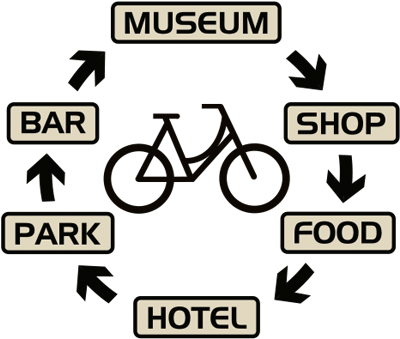
Use a bike your entire stay